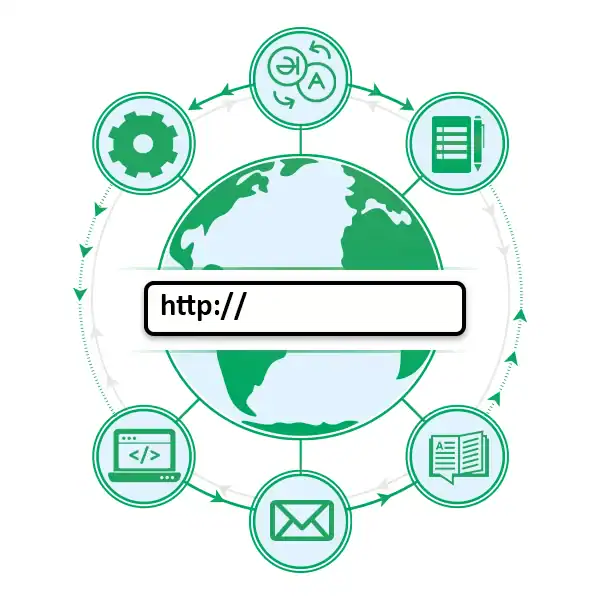
Website Translation Services for Global Growth
Your website speaks a lot about your business and the way you want to reach a global audience.
TranslationPartner offers website translation services built for real international growth. We’re an expert website translation services company.
At TranslationPartner, we adapt your website content both culturally and technically to help you reach your target global audience smoothly and boost your sales. We serve eCommerce brands, SaaS companies, eLearning platforms, and SMEs expanding into new markets.
Our website translation services are available in more than 50 languages, bridging the gap between your business and your potential global buyers.
Don’t hesitate; reach out to us now and enjoy global business expansion!
What Are Website Translation Services?
Website translation is the process of converting website content from one language into another. This ensures your content is accessible to international customers, using their local language, terminology, and respecting their cultural context.
Translating website content requires professional translation services that ensure linguistic accuracy, grammatical correctness, and cultural sensitivity in the target language. Translation serves as the linguistic bridge.
Our multilingual website translation services typically cover informational content, corporate pages, databases, internal portals, meta description and meta titles.

Website Translation vs. Localization
Website localization goes beyond translating texts. It’s a comprehensive process of adapting your entire website to meet the cultural, social, technical, and linguistic nuances of the target audiences. In other words, it’s about creating a stronger connection, establishing trust, and giving the impression that your website was made specifically for that local audience. Localization serves as the cultural hub.
Localization Key Elements

The Importance of Search Engine Optimization (SEO) in Localization
Search engine optimization drives organic traffic and improves global visibility. Website localization includes comprehensive keyword analysis in the target language, focusing on local search patterns and expressions. Effective website localization services identify keywords that resonate culturally, optimize meta descriptions, and ensure local search engines can easily find your website. A final thought: Localization and translation work together. Localization never replaces translation.
Instead, successful website localization depends on quality translation of website content. You cannot effectively adapt content culturally if the initial linguistic work is not accurate.
Benefits of Professional Website Translation and Localization
Request a Free Quote for Translation Services
You can ask for a FREE quote with no commitment on your side & get a reply in less than 24 hours.
Our Website Translation & Localization Process
TranslationPartner believes that clarity delivers quality website translation and localization services. Therefore, our structured process ensures accuracy, relevance, and engagement. The website translation and localization process includes content extraction, terminology and glossary creation, professional translation and proofreading, SEO localization and CMS integration, and quality assurance.
Here is an explanation of each step:
Content Extraction
We review your website content and distinguish important content, such as landing pages or product pages, from static content. Then, we extract all text, including database content and hard-coded strings, ensuring nothing is missing. Furthermore, we also establish a style guide to maintain consistency across all translators.
Terminology & Glossary Creation
Consistency builds brand authority. We collaborate with you to develop a glossary containing industry jargon, brand-specific terminology, and “do-not-translate” words such as brand names. This glossary ensures your voice remains consistent across all languages.
Professional Translation and Proofreading
Translating textual content is the core of website localization. This covers all written content: product descriptions, blog entries, FAQs, and website copy. Our expert translators ensure accuracy, cultural and contextual relevance. Then, professional proofreaders review every page for quality and consistency, ensuring error-free content.
SEO Localization
(Metadata & Keywords)
Translating textual content is the core of website localization. This covers all written content: product descriptions, blog entries, FAQs, and website copy. Our expert translators ensure accuracy, cultural and contextual relevance. Then, professional proofreaders review every page for quality and consistency, ensuring error-free content.
CMS Integration & Quality Assurance (QA)
Finally, we integrate the translated content back into your CMS. Our website translation solutions work with all top content management systems through widgets, plugins, and connectors. We conduct a full QA to ensure linguistic accuracy, formatting consistency, and functionality, avoiding any potential issues before launching the translated website.

Key Factors for Successful SEO-Optimized Website Localization
Localization, as mentioned above, is a comprehensive process that involves the culture, language, preferences, and regulatory requirements of specific target markets. Here are key SEO best practices for multilingual website localization that distinguish us from other website translation companies.
Multilingual Keyword Research
We conduct comprehensive market research for each target language and region, exploring local trends and preferences. This multilingual research is the basis for the professional website localization service, ensuring that the content and approach are tailored to the target audience.
Localized Search Behavior
To ensure your website reaches the right people, we think like local users. We understand how people search in each market and what keywords they use. This ensures our localization service is compatible with SEO requirements.
URL Structure Adaptation
Localized URLs for each target market improve both SEO and user experience. Clear URL structures help search engines understand your site’s relevance to specific regions and build user trust.
Hreflang implementation
Hreflang implementation is essential for international SEO. Hreflang tags differentiate between sites in various languages using country codes (like <link rel=”alternate” hreflang=”fr” />). This technical approach targets specific regions and prevents duplicate content across different language versions.
Metadata Translation
Metadata elements that should be translated properly for each specific region to increase accessibility include:

Popular CMS Platforms for Localization Compatibility
Businesses and online stores need a well-designed translation service that can be easily accessed and understood by an international audience to increase their sales. CMS (Content Management Systems) with localization are the best to achieve your goal. Popular CMS platforms include:
These platforms handle multilingual product content and different currencies, making them ideal for e-commerce website localization.
With TranslationPartner, you are in the right place.
Website Translation for Key Industries: We Handle the Most
SaaS & Technology
We help SaaS companies expand globally using understandable language to attract users, gain their trust, and boost sales. We provide exceptional software translation with SEO localization to ensure business success. Localized content includes product UI and dashboards, onboarding flows and tutorials, pricing and billing pages, databases, and help centers
E-commerce & Online Marketplaces
E-commerce website translation is our specialty and most requested service, as businesses seek global growth. We provide SEO-optimized e-commerce translation services that increase ranking and visibility. Translated content includes homepage titles and contents, product descriptions, checkout, payments, return policy, shipping, taxes, FAQs, and customer Reviews.
Small and Medium Enterprises (SMEs)
SMEs that want to expand internationally are our frequent clients, as we provide tailored translation solutions, using proper terminology and respecting cultural nuances in compliance with legal standards. We help businesses to test new markets and increase their presence safely. Translated materials include business contracts, trade agreements, service or product descriptions, testimonials, case studies, and business blogs.
Education & e-Learning
E-Learning platforms serve international users who expect clarity and cultural sensitivity. TranslationPartner’s professional e-learning translation services ensure quality content, enhancing completion rates, satisfaction, and enrollment applications.
Our frequently translated materials include course descriptions and details, learning management systems (LMS), assessments and certifications, and enrollment and payment pages
Website Translation Pricing
Website translation costs can be priced based on the number of hours at a price per word. The price per word range is USD 0.08 – 0.15, and the hourly rate range is USD 35-55. The key factors that affect the website translation price include language pairs, project volume, SEO scope, and CMS complexity. Here is an explanation of each one.

One-Time vs. Ongoing Localization
- One-time localization: One-time localization is the traditional website localization. This type is best for static websites with no further updates, such as finished and stable projects.
- Ongoing localization: on the other hand, supports continuously updated sites. As you add content, new material flows automatically into your translation workflow.
The cost of both is variable; ongoing localization reduces long-term costs.
TranslationPartner provides both models at competitive prices, tailored to your needs.
Why Quality of Website Translation Affects ROI!
ROI (return on investment) measures whether website translation delivers value. Quality translation ensures accuracy, culturally relevant design and visuals, targeting a specific region using their languages and local idioms. When you invest in quality translation, you invest in your business, increasing your revenue.
Cheaper translation is more costly than you think; with poor quality, you ruin your credibility and trust. At TranslationPartner, you invest in a professional website translation service to protect your brand image while expanding your global reach.
Why TranslationPartner Is Your Best Website Translation
and Localization Partner!
We are a certified translation agency with ISO certifications ensuring quality and legal compliance globally.
Here is why clients choose us:
50+ languages covered
We cover more than 50 languages, from common languages to the most specialized languages, such as Chinese, Swahili, Arabic, and more. We help you connect with your target market effectively.
1,500+ vetted linguists
Our team includes over 1,500 vetted linguists who are native speakers with subject matter expertise in different domains. We have particularly strong capabilities in the MENA and African regions, which are great markets for global growth.
Long-Term Partnership Model
We bet on your success as our own; our ongoing multilingual website localization services support your continued international growth across multiple regions. As your products, policies, and campaigns evolve, we ensure all language versions stay updated and optimized.
Human translation with AI integration
As a professional website translation company, we adapt AI translation tools along with human expertise. We leverage human expertise to ensure speed, consistency, and SEO optimization. We use top AI software alongside CAT tools and machine translation, always with human oversight. At TranslationPartner, we professionally use different platforms and handle versatile HTML files.
Quality Assurance Process
Professional website translation services need to be as good as the client desires to increase their global presence and boost sales. TranslationPartner conducts a rigorous quality assurance process to check translation accuracy, linguistic errors, and consistency. At the same time, our development team checks every technical element, including tags, layout, breaks, and more, ensuring top-notch website localization within SEO standards.

How to Choose the Best Website Translation Company
A professional translation company is a guarantee that your website will stand out from other competitors, providing global growth.
The key points to choose the best website translation company are:
FAQ’s